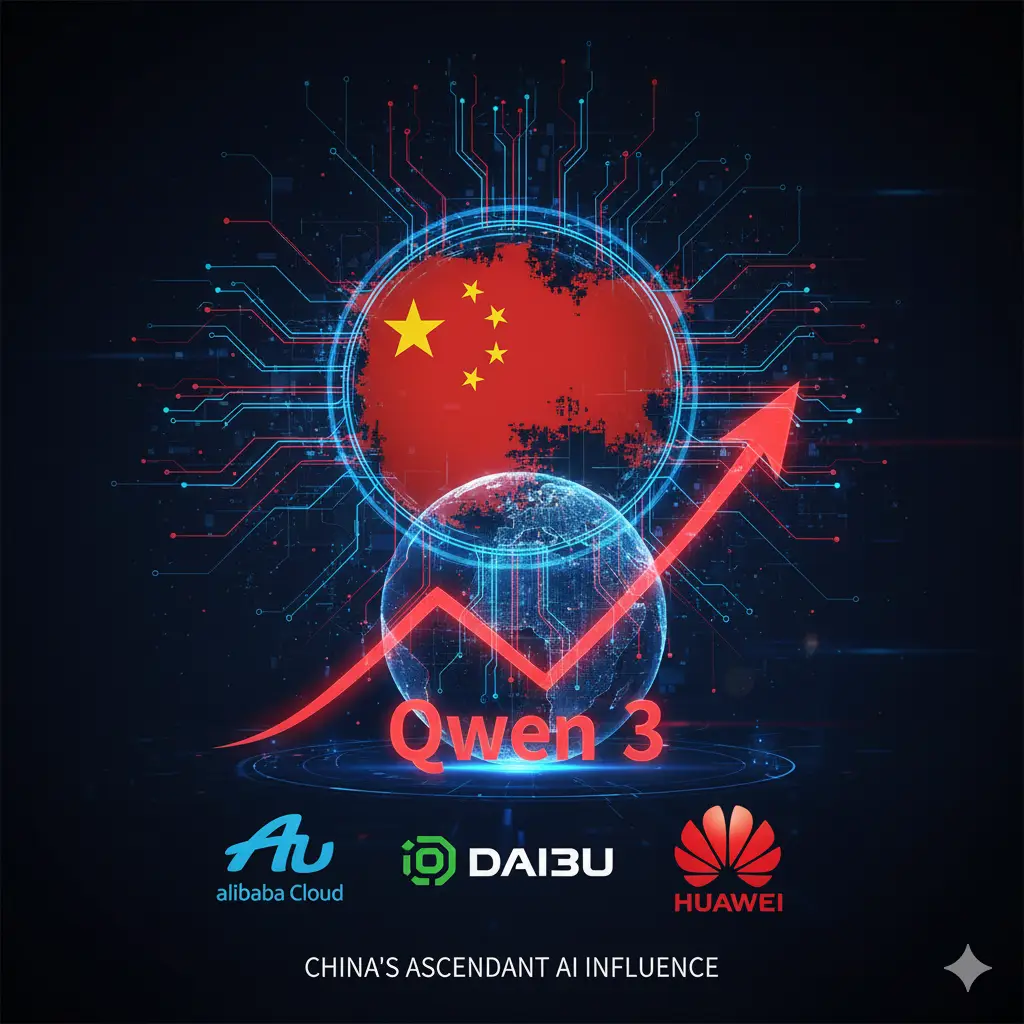
China’s AI Explosion: How Qwen 3 and Open-Source Strategy Are Rewriting the Global AI Race
China’s AI race is accelerating — and this time, it’s not just about catching up. With the launch of Qwen 3, a new large language model from Alibaba Cloud, China is positioning itself as a global AI powerhouse.
The move marks a strategic pivot toward open-source dominance and technological self-reliance. As the U.S. tightens chip export controls and the West centralizes AI behind closed APIs, China’s approach — open, scalable, and domestic — could redraw the global AI map.
What Happened
In September 2025, Alibaba’s DAMO Academy unveiled Qwen 3, the successor to its already powerful Qwen 2.5 model. With performance benchmarks rivaling GPT-4 and Claude 3 Opus, Qwen 3 delivers massive context understanding and multilingual reasoning — supporting over 50 languages natively.
Key Highlights:
- Architecture: Transformer-based hybrid model with fine-tuned Chinese-English bilingual optimization.
- Performance: Scores 89.2 on MMLU, surpassing GPT-4 Turbo in reasoning-heavy tasks.
- Open Source: Released on Hugging Face and ModelScope, with APIs for commercial use.
- Scale: Trained on over 5 trillion tokens across domestic supercomputing clusters.
- Applications: Deployed in AliGenie voice assistants, e-commerce AI copilots, and enterprise cloud APIs.
The Chinese government has backed Qwen 3’s development as part of its National AI Sovereignty Program, emphasizing technological independence from Western hardware and cloud dependencies.
Why It Matters
- Open Source as a Strategic Weapon
Unlike U.S. models like GPT-4 or Claude 4, which are closed systems, Qwen 3’s open-source model allows startups, universities, and local governments to fine-tune and deploy AI at will.
This creates a massive innovation multiplier across China’s tech ecosystem — similar to how Linux transformed enterprise computing.
It also ensures resilience against export restrictions: even if access to NVIDIA or AMD chips is limited, domestic accelerators (like Biren and Huawei Ascend) can run Qwen efficiently.
- The Rise of AI Nationalism
Beijing’s policymakers are framing AI as a national security and economic engine. According to China’s Ministry of Industry and IT, the country’s AI sector is projected to surpass USD 125 billion by 2030, driven by education, healthcare, manufacturing, and fintech applications.
By going open source, China not only builds local talent pipelines but also extends influence to developing markets seeking affordable AI infrastructure — particularly across Southeast Asia, Africa, and Latin America.
- Global Competitive Shockwave
Western firms are now watching closely. While OpenAI and Anthropic fight for enterprise dominance, China’s Qwen 3 and Baidu’s ERNIE 5.0 are quietly building global developer ecosystems.
This could trigger a “two-system AI world” — one open and state-backed, another closed and commercially driven. The results may shape not just tech markets, but the future of digital governance.
- Innovation Through Necessity
With limited access to U.S. chips, Chinese firms have doubled down on hardware-software co-design. Alibaba, Huawei, and Tencent are now developing AI accelerators optimized for local LLMs.
Qwen 3’s efficiency shows results: its training power consumption was 37% lower than comparable Western models — a sign that constraints are forcing innovation.
What’s Next
- Qwen 3.5 is already in internal testing with extended context windows (up to 1.5 million tokens).
- Huawei Ascend 1000 chips are being deployed across new AI data centers to power open Chinese models.
- Expect an AI alliance between Alibaba, Baidu, and iFlytek, pooling datasets for shared model advancement.
- China will likely export open AI frameworks through its Belt and Road Digital Initiative — bringing Qwen to 30+ countries by 2026.
If the open-source approach continues to outperform closed systems in adaptability, global AI collaboration may realign eastward — with China setting de facto standards in AI transparency and scalability.
“China’s AI playbook is simple: open the code, close the gap, and control the future.”
KEY TAKEAWAYS
- Alibaba’s Qwen 3 challenges GPT-4 and Claude with open-source access and 50+ language support.
- Represents China’s shift to AI sovereignty and self-reliant supercomputing.
- Could reshape global AI geopolitics — dividing the world between open and closed ecosystems.
- Backed by state funding and deployed across cloud, commerce, and consumer tech.
- Signals a new era of AI nationalism and global open innovation.