The Rise of Agentic AI: From Chatbots to Autonomous Systems
The Rise of Agentic AI: From Chatbots to Autonomous Systems
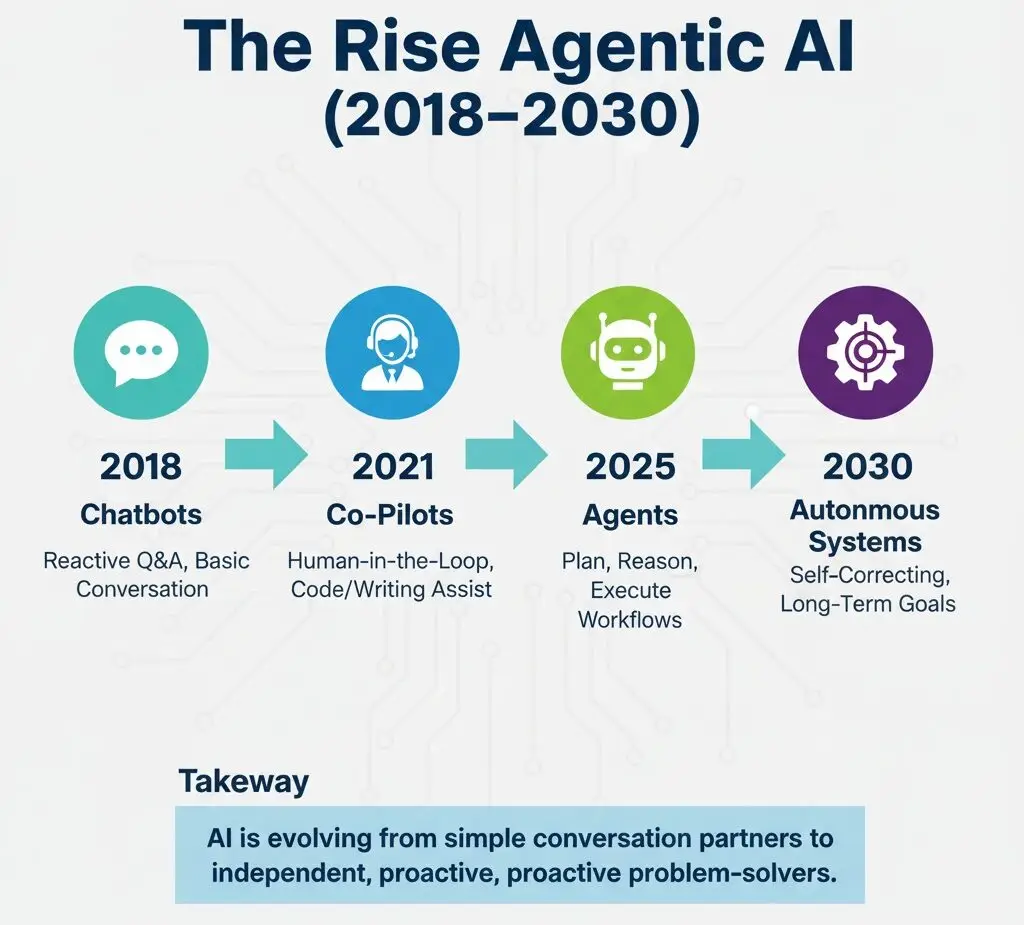
Artificial intelligence is shifting from reactive chatbots to proactive agents. The year 2025 marks a turning point: AI is no longer just generating answers, it’s planning, reasoning, and executing workflows. This is the era of agentic AI.
🔹 What Is Agentic AI?
Agentic AI refers to systems that don’t just respond — they act with autonomy. Unlike chatbots, which only generate one-off answers, agents:
-
Plan multi-step tasks.
-
Adapt based on outcomes.
-
Execute without constant human prompts.
Anthropic’s Claude Sonnet 4.5 sustaining 30+ hours of reasoning, or AutoGen enabling multi-agent conversations, are early examples of this shift.
🔹 Why It Matters Now
-
Productivity Gains → Agents can handle entire coding cycles, research reports, or simulations with minimal input.
-
Reduced Human Oversight → Less “prompt babysitting,” more true delegation.
-
Risks Magnified → Autonomy means errors can compound faster, with greater real-world consequences.
-
Ecosystem Growth → Frameworks like LangChain, CrewAI, and AutoGen are maturing, giving developers plug-and-play agent tools.
🔹 Challenges Ahead
-
Robustness: Agents still stumble in ambiguous or adversarial scenarios.
-
Transparency: How does an agent reach a decision? Black-box reasoning remains a challenge.
-
Control: When should a human step back in? Oversight mechanisms are still evolving.
-
Safety: Misaligned goals in autonomous agents could create high-stakes failures.
🔹 Looking Ahead to 2030
-
Hybrid Models: Expect “human-in-the-loop” oversight for sensitive domains like healthcare and law.
-
Vertical Specialization: Agents trained for finance, medicine, or robotics will outpace general-purpose ones.
-
New Benchmarks: Long-horizon, adaptive tests will replace static benchmarks like MMLU.
-
Ethics & Regulation: Policymakers will face pressure to set limits on what autonomous AI can do without human approval.